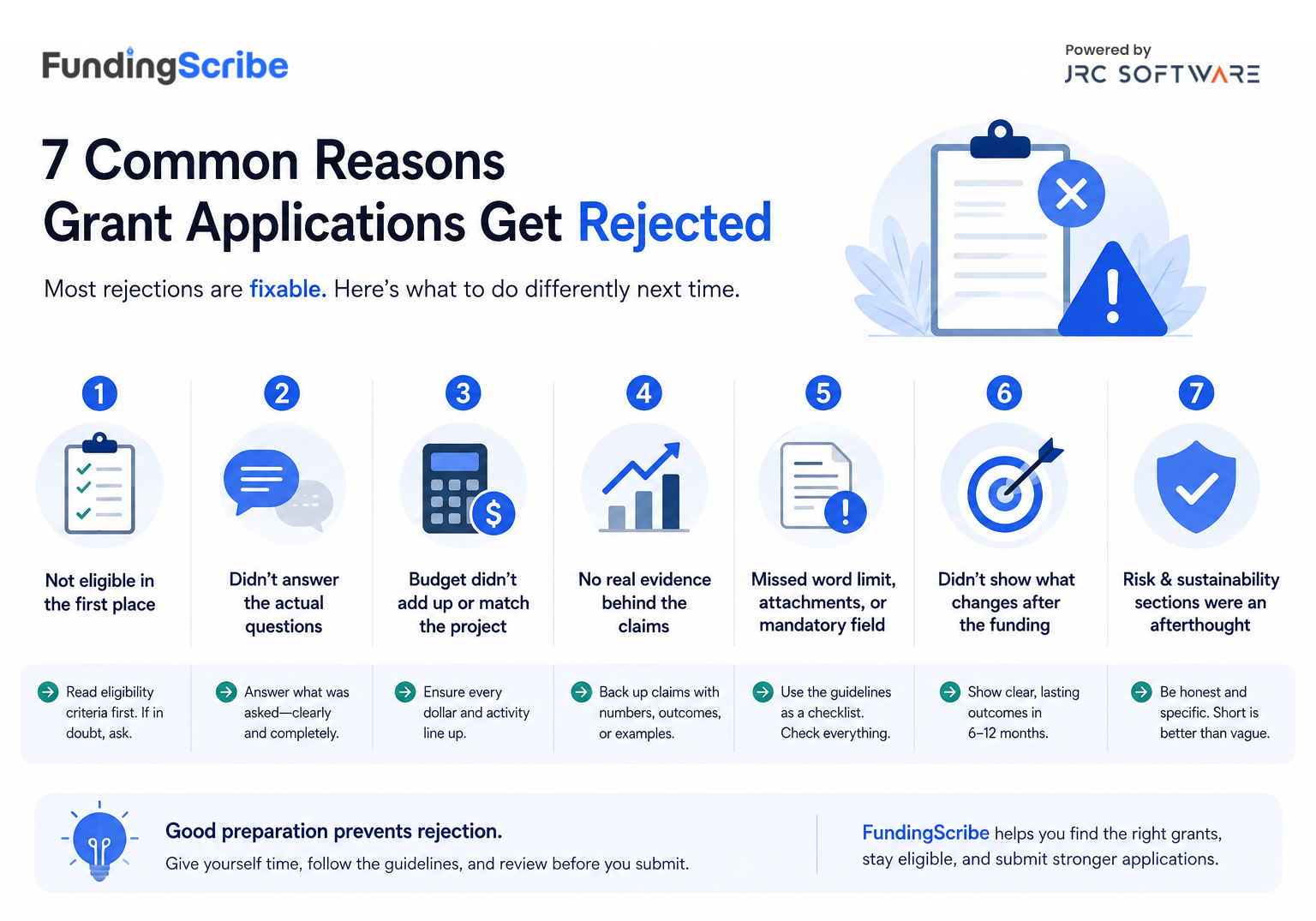
Why Australian Grant Applications Get Rejected
Getting a rejection email after weeks of work on a grant application is a particular kind of frustrating especially when the feedback is just a generic "not successful this round" with no real explanation. Most of the time, the reasons behind a knock-back are more ordinary than people expect. It's rarely about the cause not mattering enough. It's usually something fixable.
Here are the reasons Australian grant applications most often get rejected, and what to do differently next time.
The organisation wasn't eligible in the first place
This is the most common rejection reason, and the most avoidable one. Funders set eligibility criteria for a reason entity type, location, project category, co-funding requirements and applications that don't meet them get screened out before anyone reads the project narrative.
It happens because teams fall in love with a grant before checking the fine print. The fix is simple: read the eligibility criteria first, line by line, before writing anything. If there's any doubt, call the funding body and ask. A five-minute phone call can save weeks of wasted writing.
The application didn't answer the actual questions
Assessors aren't grading on enthusiasm they're checking whether each question was answered, specifically and completely. A common pattern is applicants reusing content from a previous application that's close enough to the question but not quite on point.
If a question asks how you'll measure success and the response talks about your organisation's history instead, that's a gap an assessor will notice immediately. Go through every question and check the answer actually responds to what was asked, not what you wished was asked.
The budget didn't add up or didn't match the project
Budgets get more scrutiny than almost anything else in an application, and vague line items are an easy way to lose points. "Marketing costs: $5,000" tells an assessor nothing. They want to see how the number was worked out and how it connects to the project described elsewhere in the application.
Mismatches are another common issue a budget that includes costs for activities never mentioned in the project plan, or a project plan describing work the budget doesn't cover. Before submitting, check that every dollar in the budget maps to something specific in the narrative, and that every activity in the narrative has a cost attached somewhere.
There was no real evidence behind the claims
"Our program has a strong track record in the community" means nothing to an assessor without numbers attached. Funders want proof, not confidence. Past outcomes, participant numbers, measurable results, even a short quote from someone the program helped these carry far more weight than strong language ever will.
If a sentence makes a claim, it should be followed by the evidence for that claim. If there's no evidence available, that's worth noting honestly rather than papering over it.
The application missed the word limit, attachments, or a mandatory field
This sounds minor, but it's a frequent cause of automatic disqualification. Funders set limits and requirements for practical reasons, often tied to assessment workload or legislative requirements, and most portals won't let an incomplete application through or worse, they will, and it gets rejected on a technicality after the fact.
A final pass against the guidelines as a checklist, not just a read-through, catches most of these before submission.
The project didn't show what changes after the funding
A lot of applications spend most of their word count describing the problem and very little on what specifically happens differently because of the grant. Funders are investing in an outcome, not just acknowledging that a problem exists. If it's not clear what's different in six or twelve months more people reached, a new capability built, something that continues after the funding ends the application reads as incomplete even when the writing itself is good.
The risk and sustainability sections were an afterthought
These sections often get the least attention because they're the least interesting to write, but they're frequently where assessors look to judge whether an organisation has actually thought the project through. A short, honest risk section beats no risk section, and a vague sustainability statement reads worse than admitting funding may need to be revisited after the project period.
Many of these issues can be prevented by giving yourself enough time to prepare, carefully reading the funding guidelines, and reviewing your application before submitting it.
It also helps to have a consistent process for checking eligibility, organising supporting documents, reviewing budgets, and making sure every response answers the assessment criteria.
That's where FundingScribe can help.
FundingScribe helps Australian nonprofits, charities, community organisations, and SMEs simplify the grant application process by helping you:
Find funding opportunities that match your organisation.
Check your eligibility before spending hours on an application.
Reuse information from previous grant applications and organisational documents.
Keep your responses consistent and aligned with the funding criteria.
Review your application for missing information, compliance issues, and required documents before submission.
Instead of worrying about avoidable mistakes, your team can spend more time strengthening your proposal and demonstrating the impact of your work.

.png)