Grant Writing
Why Australian Government Grant Applications Fail and How to Fix Them
Why Australian Government Grant Applications Fail at the Administrative Hurdle
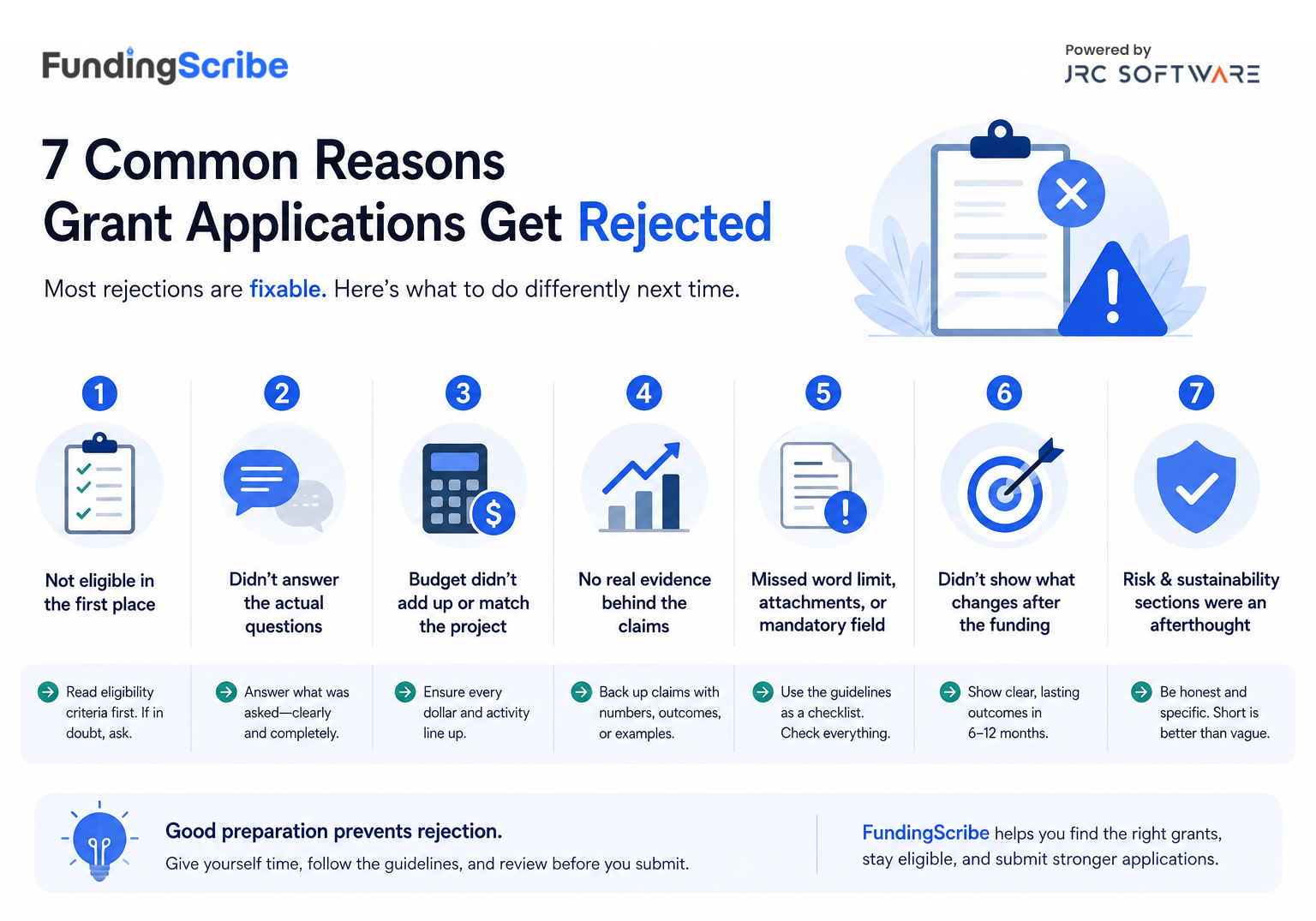
For programme officers and funders who routinely assess grant-seeking organisations, the pattern is a familiar one: a well-conceived application, clearly articulating community need and organisational capability, is set aside before merit is ever considered. In the Australian Government context, this outcome is more common than it should be, and the causes tend to cluster around three persistent failure points.
The first is incomplete or inconsistent documentation. Commonwealth funding rounds typically require a precise set of supporting materials financial statements, constitutional documents, board resolutions, and insurance certificates among them. Applicants frequently submit documents that are outdated, internally inconsistent, or formatted in ways that do not meet agency specifications. Where a portal requires certified copies and uncertified scans are submitted, the application is generally ineligible regardless of its programmatic strength.
The second failure point is eligibility verification. Australian Government funding is often restricted by legal entity type, Australian Business Number registration status, Australian Charities and Not-for-profits Commission registration, or geographic mandate. Organisations sometimes apply to rounds for which they do not formally qualify, either through misreading the guidelines or assuming that a close fit is sufficient. Agencies assessing applications at scale rarely have discretion to overlook a missed eligibility threshold.
The third, and increasingly consequential, issue is system navigation. Commonwealth funding is administered across multiple portals including GrantConnect and agency-specific platforms each with distinct submission workflows, file-size limitations, and declaration requirements. Technical errors made in the final stages of submission, such as incomplete declarations or incorrectly categorised attachments, can render an otherwise complete application invalid.
Understanding where applications fail procedurally is the necessary first step before considering how to structure a stronger submission from the outset.
A Step-by-Step Roadmap for Navigating Australian Government Funding Systems
With the failure points clearly mapped, the practical question becomes how to build a submission process that addresses each of them systematically. For programme officers guiding applicant organisations or assessing the rigour of those organisations' internal processes the following sequence reflects current Commonwealth practice.
Identifying the correct programme is the appropriate starting point. GrantConnect (grants.gov.au) is the authoritative source for Commonwealth grant opportunities, consolidating listings from across portfolio agencies. Searches should be filtered by category, eligible recipient type, and open status. It is worth cross-referencing against individual agency website the Department of Health, the Department of Social Services, and the National Indigenous Australians Agency, for example, each publish additional guidance that supplements the GrantConnect listing.
Once a relevant opportunity is confirmed, the next step is a systematic eligibility review against the published guidelines. This means checking entity type, ABN and ACNC registration requirements, geographic restrictions, and any minimum organisational capacity thresholds before any substantive drafting begins. Time spent on an ineligible application is time unavailable for a suitable one.
Evidence preparation should then follow a document checklist drawn directly from the application guidelines, not from previous rounds or comparable programmes. Commonwealth requirements shift between funding cycles. Key documents to prepare and date-check typically include:
Audited financial statements within the specified recency window
Current constitutional or governing documents
Board or committee authorisation resolutions
Public liability and professional indemnity insurance certificates
Any co-contribution or partnership letters required by the guidelines
Submission through GrantConnect or the relevant agency portal should be treated as a milestone in itself, not a final step. Organisations and the programme officers supporting them should plan for portal registration, practice submissions where available, and final upload no fewer than 48 hours before the published closing time. Commonwealth portals do not generally accommodate late submissions regardless of technical circumstances, and closing times are enforced precisely.
Tracking key dates in a shared calendar including the opening date, any pre-application webinar registrations, the submission deadline, and the anticipated notification date provides the oversight structure that keeps a submission on track across its full preparation window.
.png)